
The Pause: What Distance Gives You Before the Next Chapter

On why stepping back isn't giving up — and what becomes visible when you finally do.
Roger says it all the time, in sessions, in conversations, in the quiet moments when I've come to him spinning:
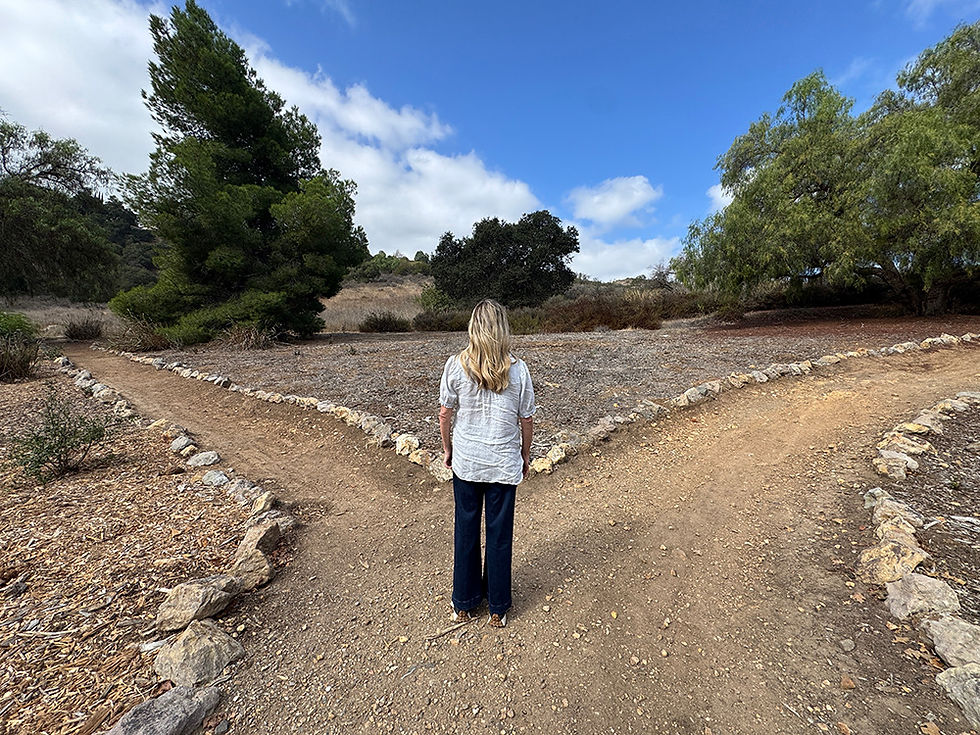
"The answer is in the pause."
I used to hear that and think, yes, of course, that makes sense. And then I started testing it. In small moments first, a reaction I was about to have, but took a few breaths instead. A response I held back long enough to let settle. A conversation I stepped away from before the ego could take over.
It worked every time.
But recently, life gave me the chance to test it in a big way. And now I know it the way you know something that has genuinely changed you.
The pause isn't the empty, uncomfortable gap between the pain and the resolution.
It IS the resolution.
You Can't See the Pattern From Inside It
Here's something I've come to believe deeply, and that Roger sees confirmed again and again in his intuitive work with clients:
When you're inside an unhealthy dynamic, your nervous system is working overtime just to manage it. Reading the room. Bracing for the next comment. Deciding whether to say something or let it go. There's no spare bandwidth left to also step back and ask: wait, is this relationship, this friendship, actually good for me?
That question requires distance. Not because you're not smart or self-aware enough to see it up close, but because your body is too busy regulating the relationship in real time to also evaluate it.
The pause creates the distance. And the distance creates the view.
What Six Weeks Gave Me That Years of Friendship Didn't
I saw this play out recently in a friendship.
She lived abroad. We'd Marco Polo a few times a week. There was real history between us, genuine laughter, and moments of true connection. But she also had an edge, sharp opinions, backhanded comments, little digs I'd usually catch and gently correct in the moment. I stayed close for a long time, managing the aftermath of most of our conversations as I went. Without realizing that's what I was doing.”
Then, right in the middle of sharing one of the happiest weekends of my engagement, she said something deliberately aimed at that wide-open moment. She delivered it with anger. She even prefaced it with: "This may make you mad, but I have to risk it."
She risked it. And in doing so, she showed me exactly who she was.
After one honest response, I went quiet. She offered what amounted to an "I'm sorry you took it that way," which told me everything I needed to know about where this was going. So I stepped back. Not forever, I told myself. Just long enough to figure out what I was feeling and where I wanted this friendship to go. To sit with it before making any decisions. To keep my energy exactly where I wanted it, not in a back and forth that would drain me and resolve nothing.
What those six weeks gave me, the years of friendship never had.
For weeks I turned the same question over and over: how could someone I called a friend want to hurt me like that? I waited for an answer that made sense. Something that would explain it, soften it, make it forgivable. And then one morning, quietly, the question changed.
It became: how could you call someone friend who intentionally tries to hurt you?
That was the reframe. That was what the pause gave me. No amount of back and forth could have gotten me there. Only the stillness could.
It became obvious, quietly and undeniably, that she had always been a little mean. Not dramatically. Not constantly. But consistently, in a low hum kind of way that I'd been too close to name. What she said that day wasn't a one-off. It was just the loudest example of a pattern I'd been managing for years without ever seeing its shape.
From inside the friendship, I was correcting her. Making excuses. Staying connected. From outside it, I could finally see the whole thing instead of just the individual moments.
I knew these things to be true: you can't change anyone. Someone has to want to repair what they've damaged. And I no longer wanted my energy going anywhere that made me less than I am.
She eventually wrote me a letter, carefully crafted, that essentially said she felt she had to walk on eggshells while giving any feedback on my life. MY life. Not hers. Mine. As if the problem wasn't what she had said, but that I had made her feel uncomfortable for saying it. I'll be honest, had I been drinking milk when I read that, it would have come straight out of my nose.
And something else became clear, where in me that had come from. The staying when someone didn't treat me well. The tolerating of someone who couldn't simply listen and support without inserting their opinions. She was, I realized, the last expression of an old paradigm. Something I was used to in childhood, still quietly attached, still familiar enough to feel like connection even when it wasn't.
The pause showed me all of that. Softly. In ripples.
You know how it is when you drop a pebble into still water, the ripples are big at first and then they even out into calm? That's what the six weeks felt like. The initial anger. The temptation to say everything I wanted to say in perfectly chosen words. And then, gradually, the settling. Until one day I realized I had no investment left. No desire to win. No need for resolution from her. Just peace. And a clear, quiet knowing that I was done.
Something happened in that space that I didn't expect. I got lighter. The way you feel buoyant when something heavy has been quietly lifted, I rose up a little. And from that higher place, I could see so much more. I could see what all the years had actually looked like. All that I had tolerated. All that I had explained away, as if preserving the friendship was the prize.
It wasn't. The peace of clearly seeing what it was, that was the prize.
I'd meet friends for lunch and feel the difference immediately. There was peace in my home. Peace around me. No one standing as judge and jury to my happiness. I was free.
And nothing in me wanted to go back.
Why the Ego Hates the Pause
Here's why so many people skip it.
The pause is uncomfortable. Really uncomfortable. And the ego, which wants to prove, to win, to have the last word, to be understood, has absolutely no interest in sitting quietly with discomfort when there's a perfectly good argument to be had.
I felt it. That temptation to say what I wanted to say. To package it beautifully and deliver it precisely. But I knew where that road went, straight back into the dynamic I was trying to see clearly. Back into managing. Back into the noise.
But I stepped back instead. I took the space without fear of losing someone who had just intentionally popped my happy bubble. That's where the power is. Not in the response. In the pause before it.
I'll admit, even in my six weeks, there was a moment where I almost talked myself out of it. A flicker of maybe she's just going through something. Maybe that old version of her I used to love will come back. That thought is completely normal. It doesn't mean you're wrong to be pausing. It means the pull back toward the familiar is strong, even when the familiar wasn't good for you.
The skill isn't never feeling that flicker. It's not acting on it. Let it pass through. Stay in the pause anyway.
And I'll say this too, because I think it needs to be said: the pause isn't just uncomfortable. Whether it involves romantic love or the love of a deep friendship, it can be grief. Real, legitimate grief. The thought of letting go of someone who has been part of your life, your daily rhythms, your sense of home, is not a small thing. It doesn't matter whether the relationship was good for you or not. Loss is loss. And the pause asks you to sit with that loss without rushing to resolve it.
This is not a quick little jaunt to transformation. It never was. But on the other side of that grief, if you stay in it long enough, something begins to clarify. The fog lifts just enough to see what was actually there. And that clarity is worth every uncomfortable moment of the pause.
What the Pause Is Actually For
If you're in it right now, freshly out of something, or finally giving yourself permission to step back, here's what this space is actually for:
Notice your body, not just your thoughts. Are you more settled without this person or situation? More tense? Your nervous system often knows before your mind catches up.
Resist the urge to resolve it in words. You don't need the other person to agree with you, apologize, or understand. The clarity doesn't require their participation.
Let the flicker come and go. It will probably show up. Don't fight it. Just don't let it drive.
Give it real time. Not a weekend. Long enough for the noise to quiet and the pattern, not just the incident, to come into view. You'll know when you've given it enough time. The ripples will have mellowed. You'll find yourself at peace with where you've landed, not because you forced it, but because you finally got still enough to see clearly.
What This Has to Do With Love
We talk about this in our work all the time, the importance of the pause between relationships. Not as a vague suggestion to "take some time to heal," but as a real, active, transformative practice.
Because here's what I know now, having lived it:
The pause isn't what you do while you wait for the next chapter to begin. It's how you make sure the next chapter is actually different from the last.
Without it, we carry the patterns forward. The familiar dynamics. The tolerations we've normalized. The ways of being that feel like connection even when they're quietly costing us something.
With it, with real distance and real quiet and real time to let the ripples settle, we rise. We get the view. We begin to see clearly what we've been accepting, what we've been explaining away, and what we've been calling connection when it was something far less.
And we walk into whatever comes next more free. More clear. More fully ourselves.
I'm walking into my marriage nine months from now having shed the last expression of an old paradigm. Not because I planned it that way. Because the pause showed it to me. And I am genuinely grateful that it happened when it did. This is one of the quiet gifts of age and time, the ability to finally see what you've been looking at for years. And to choose differently.
I'm walking into this marriage bringing everything the pause gave me, the clarity, the peace, the knowing. And leaving behind what no longer fits. Not by force. Just by having finally outgrown it.
That's the gift of the pause. It always shows you something you couldn't see before.
A Note on Roger's Intuitive Work
Roger has spent over 30 years as a psychic-intuitive. And one of the things his clients return to again and again, sometimes years later, is this:
A session with Roger is its own kind of pause.
It's the experience, with gentle, compassionate guidance, of stepping outside the noise of your own thoughts, your own fears, your own familiar narratives, long enough for something clearer to come through. Something you couldn't access from inside the dynamic. Something that was always there, waiting for the quiet.
The pause takes you to a new vantage point. And from that vantage point, you can see so much more than the managing and regulating ever allowed. Working with Roger does exactly that; it lifts you out of the noise and gives you the view.
If you've been circling something: a relationship, a pattern, a decision you can't quite seem to make, and you sense that what you need isn't more thinking but more clarity, a session with Roger might be exactly the pause you've been looking for.
With love,
Kim


Comments